I was never taught about money.
Growing up, personal finance wasn't something we talked about. I made good money at various points in my life and proceeded to waste it on... well, everything. Gadgets I used once, subscriptions I forgot about, impulse purchases that seemed important at 2 AM.
Eventually, I figured things out. Read the books, learned about compound interest, started investing. But when I tried to plan for retirement, every calculator I found did the same frustrating thing:
"You have $X, saving $Y per month, here's what you'll have in 30 years!"
Cool. But that's not the question I needed answered.
What I wanted to know was: "I'm 35, I have $50k saved, I want to retire at 65 with $2M. How much do I need to save each month to get there?"
Nobody's calculator did that. So I built one. That was the start of Common Cents Academy.
The calculators worked. But the more I thought about who the site was for, the more I realized I'd answered the wrong question again.
Someone just starting out doesn't need to know their monthly savings target to the dollar. They need to know what to do first. Pay off the credit card or save for emergencies? Get the 401(k) match or open a Roth IRA? A calculator can't tell you that. It assumes you already know.
The old site also had a problem I'm not proud of: the homepage advertised features that didn't exist yet, like an "AI financial coach." So I started over with a few rules:
- •Give people a system, not just tools. One clear order of steps, the same for everyone.
- •Be honest. Don't advertise anything that isn't built. Estimates are estimates, not promises.
- •Pick what's approachable over what's mathematically best. A plan someone sticks with beats a perfect one they quit, and when there's a more efficient option, say so.
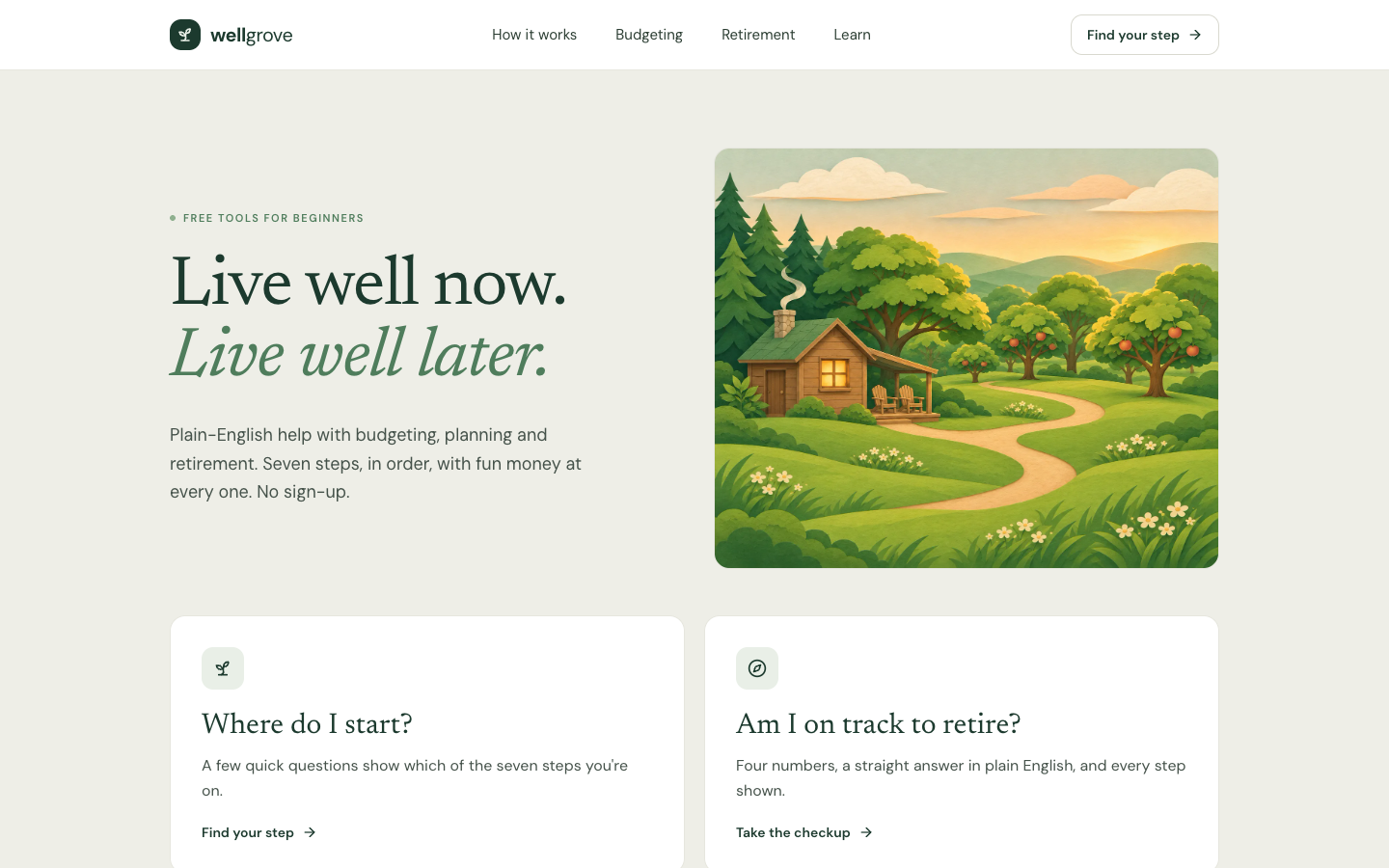
Then I found out another budgeting app was already called Common Cents. Same name, same space. So the site got a new name too: Wellgrove. You plant a grove in order, roots first, and over the years it grows into shade you can sit in. That's the whole idea.
The heart of the site is a simple system called the Planting Order. It answers one question: where does my next dollar go?
- 1.Starter cushion: $1,000 so a surprise bill doesn't go on a card.
- 2.Free money: get your full employer match.
- 3.Debt snowball: pay off credit cards and anything over 8%, smallest balance first.
- 4.Full cushion: 3 to 6 months of essential expenses.
- 5.Retirement: save 15% of your pay.
- 6.Other goals: a home, college, lower-rate debt.
- 7.Get ahead: pay the house off early, invest more, or both.
Four rules apply at every step: pay cards in full, keep your cushion separate, keep fun money at every step (never zero), and once you're on track for retirement, live a little.
Budgeting is separate from the steps, because people are different. I'm an envelope budgeter myself, but I know that doesn't work for everyone. So there are three styles: automate it, split it (like 50/30/20), or envelope it. All three feed the same steps.
None of this is invented from scratch, and the site says so. It borrows from Dave Ramsey (the starter fund and the snowball), the Money Guy Show (getting the match first and following an order), I Will Teach You To Be Rich (automate it, then spend the rest without guilt), and Die With Zero (saving so you can live). Where I disagree, I say that too. I like credit card rewards, as long as you pay the card in full. And I don't think anyone should have to live on ramen to get out of debt.
- •Find your step: a few quick questions tell you which of the seven steps you're on.
- •Budget style quiz: five questions rank all three styles for you and show a sample month with your best fit.
- •Retirement checkup: four numbers, a straight answer ("on track," "close," or "behind"), and every step of the math shown. If you're behind, it tells you how much more to save.
- •Calculators: sorted by the question you're asking. Emergency fund, the goal-based retirement calculator that started all this, compound interest, and glidepaths that show what happens when your investments get safer as you age.
- •Articles: 15 short guides, one for each step, plus Start Here, fun money, opening a Roth IRA, starting late, and budgeting when money is tight. Each one ends with one thing to do today.
Built with Next.js 16 (App Router), React 19, TypeScript and Tailwind CSS v4. Articles are MDX files with custom components for callouts, definitions, and FAQs, plus structured data so search engines understand them. Every page is pre-rendered as static HTML.
All the financial math comes from my open source NPM package: retirement-calculator. The site is the package's biggest user, and now runs on version 3.0. See my retirement-calculator project page for more about the package and its API.
- •Mobile-first: because people check their finances on their phone
- •No sign-up: the numbers you type stay in your browser
- •Privacy-friendly analytics: Umami counts visits with no cookies and no personal data, and the privacy page says exactly what's collected
- •Every calculation shows its work: no black boxes
- •Accessible: keyboard-friendly quizzes, proper headings, and focus that follows you through each question
- •Tested: 464 Jest tests, plus Playwright checks across every page at desktop and phone sizes
It's hosted on Vercel, with DNS on Cloudflare.
- •A shared profile in your browser, so you type your numbers once and every tool fills them in
- •Accounts, so you can save your progress and see how you're doing over time
- •AI that explains your results in plain English. An explainer, not an advisor
- •New contribution limits every year, as soon as the IRS announces them
Building the first version taught me the math. Building this one taught me something harder: the math is the easy part. Deciding what to tell a beginner to do first, saying it plainly, and being honest about what you don't know is the real work.
If you've ever stared at a pile of money advice and thought "okay, but what do I actually do?", this site is for you.
Wellgrove is live at [wellgrovemoney.com](https://wellgrovemoney.com). Still behind on writing articles, but less behind than before.


